WikIran obtained exclusive documents proving that Chinese company Hedsa Co., Limited is supplying the IRGC’s AIO with integral electronic components for advanced surface-to-air missile systems. The deal is executed under heavy obfuscation, so the true identity of the buyer – MODAFL – is not disclosed.
China has been Iran’s lifelong partner, its primary customer of oil and petrochemical products, importing roughly two million barrels daily and allowing Iran to bypass US sanctions in order to fund its military activities. WikIran has covered this relationship for years, notably through the prism of Iranian military entities utilizing companies to sell sanctioned Iranian oil to Chinese refineries, such fronts as MODAFL’s Sahara Thunder and the AFGS’ Sepehr Energy Jahan.
The Iran-China ties run deeper than “just” oil trade. Dual-use goods and other weapon- component transfers from China over past two decades have been a linchpin of Iran’s military arsenal. Recent media reports on Chinese arms sent to Iran include drone sensors, rocket fuel components, navigation system and even a potential deal for supersonic anti-ship cruise missiles, which we warned about in July 2025.
US Treasury sanctions and UN’s Snapback mechanism internationally outlaws all of the engagements mentioned above. Only recently did the President of the United States disclose a letter to president Xi demanding an end to all proliferation to the Islamic Republic. The Chinese president replied that claims of arms shipments were “fabricated” and that “essentially, China was not supplying weapons to Iran”. But did they really?
The complex situation in Iran and our recent publications have prompted various individuals to contact WikIran with additional material. Among the documents we received, we have verified the authenticity and accuracy of the following items.
Exposing The Deal
The documents we release today illuminate a clandestine transaction between a Hong Kong-based company, Hedsa Co., Limited, and Shahid Afshardi industry – a subsidiary of the Iranian Ministry of Defense and Armed Forces Logistics’ (MODAFL) Aerospace Industries Organization (AIO) – to purchase critical components for two Iranian SAM systems.
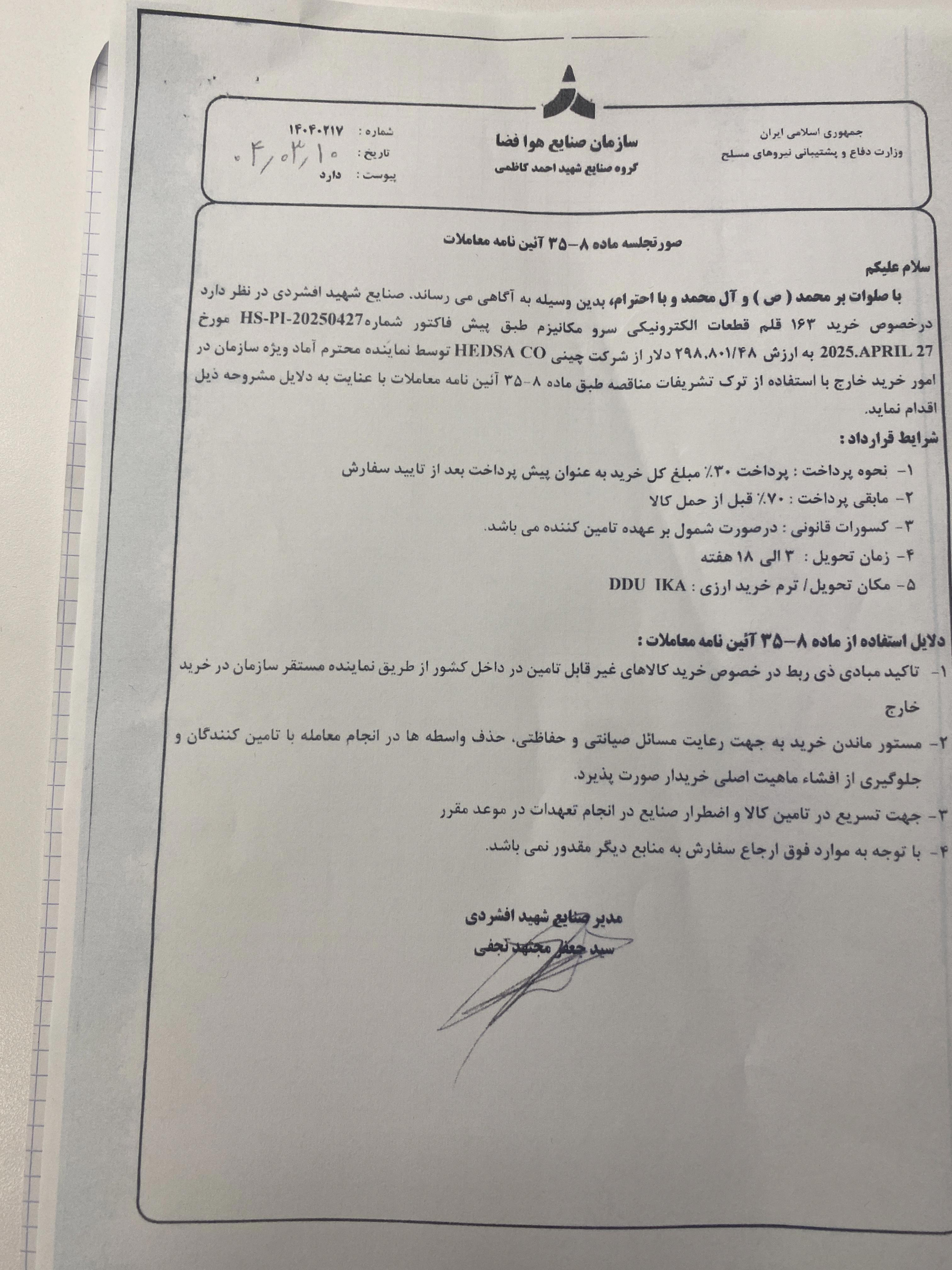
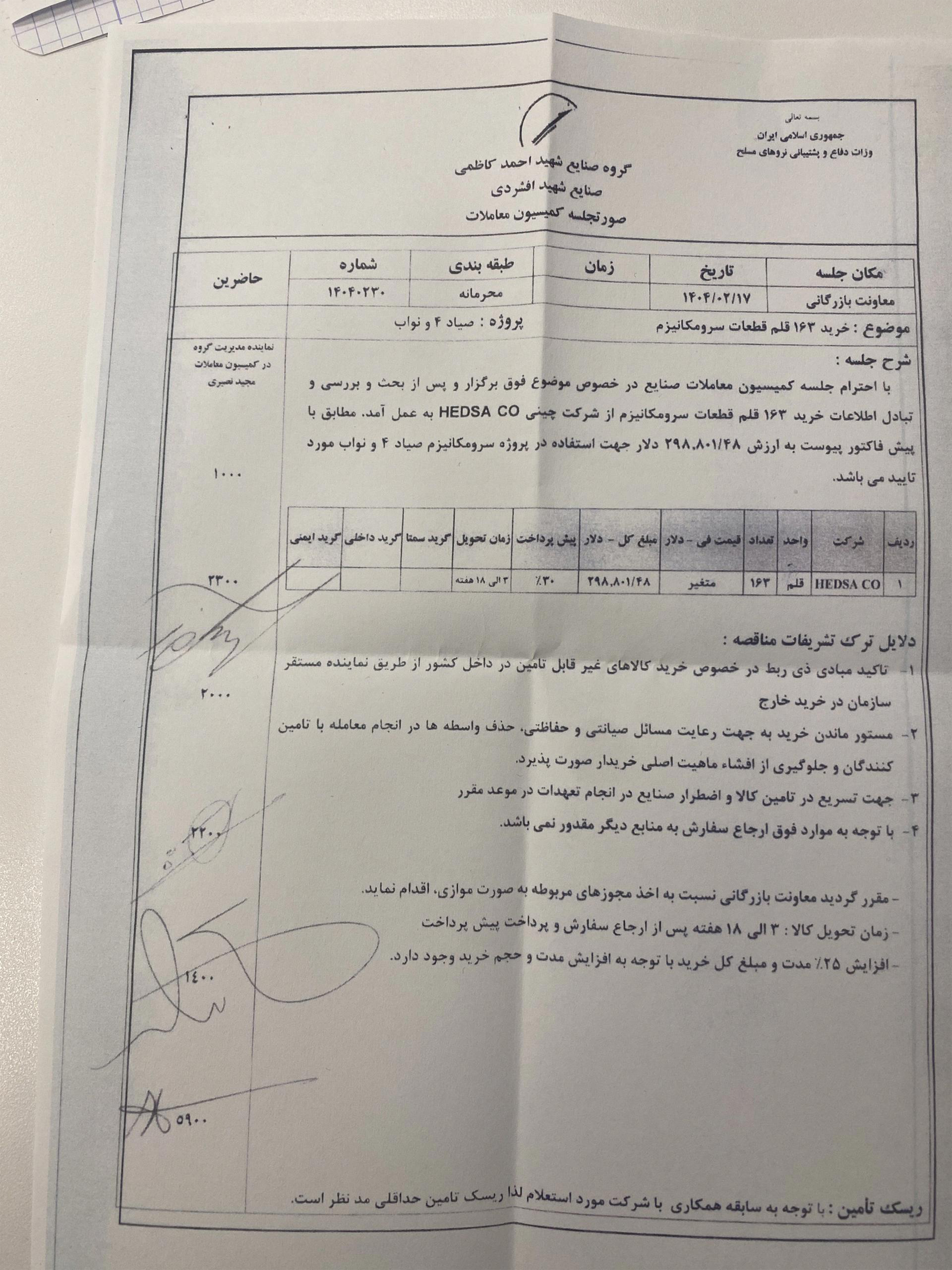
In April 2025, Shahid Afshardi Industries secured a deal for 163 Servo engines from Hedsa Co. , valued at $300,000. The Servos are intended to be incorporated in the "Navab" and "Sayyad 4" programs - advanced Iranian surface-to-air missiles. Our research indicates that the engines are intended to power the missiles’ tail fins actuators. The deal was processed through the AIO’s Special Supply entity and approved by Shahid Afshardi’s business committee. 30% (worth approximately $100,000) is payable in advance after order confirmation, and the balance is to be wired before shipment.
The Shipping is estimated at between 3 to 18 weeks and will be handled by air via Imam Khomeini Airport in Tehran (IKA), a strategic hub the IRGC frequently uses weapon transport. According to the documents, the transaction uses the DDU (Delivered Duty Unpaid) incoterm: The seller arranges transportation, while for buyer bears all import and clearance costs and risks.
Notes appended to the first file reveal unusual contractual terms: Due to sanctions imposed on Iran, procurement of military-grade goods unavailable domestically must be routed through MODAFL’s representative abroad. Additionally, no intermediaries may be involved in the contract, and special security measures are required to conceal the buyer’s true identity - MODAFL.
It remains unclear whether the transaction was completed, which currency was used or which financial institutions facilitated the payment. Based on prior experience with Iranian financial networks in China and Hong Kong, the transfer was likely executed through a front company in the country and a local branch of a major Chinese bank known for facilitating Iranian transactions - e.g., Ping An, Zhejiang Chouzhou Commercial Bank or China Construction Bank.
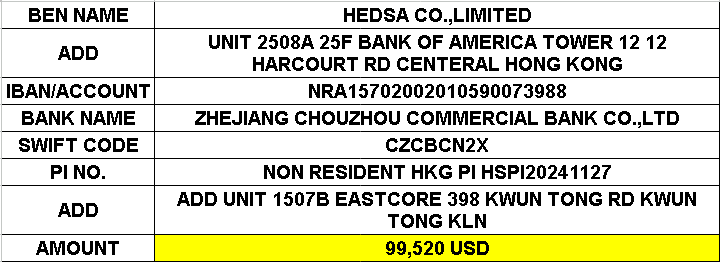
However, we have managed to uncover a bank account belonging to Hedsa Co. Limited in the Pedram Pirouzan / Opal Exchange database on WikIran. The prominent Iranian exchange house was exposed in August 2025 and was only recently sanctioned by the US Treasury for facilitating sanction-evasion and managing an extensive network of front companies that supports Iranian exporters and importers. An invoice among the exchange house leaked documents shows that 99,520 USD was paid in December 2024 to an account owned by Hedsa Co. Limited, headquartered in Hong Kong, at Chinese ZhejIang Chouzhou Bank. This account could be the same one used for the transactions described above.
| Company | Country | Bank | Account Number |
|---|---|---|---|
| Hedsa Co. Limited | China/Hong Kong | Zhejiang Chouzhou Bank | NRA15702002010590073988 (USD) |
Another unknown is whether the equipment ultimately reached the end buyer and was incorporated into the Sayyad 4 and Navab projects. If so, have those systems been employed against regional adversaries during the most recent conflict? At present, more questions remain than answers.
Meet Iran’s Shahid Afshardi Industries
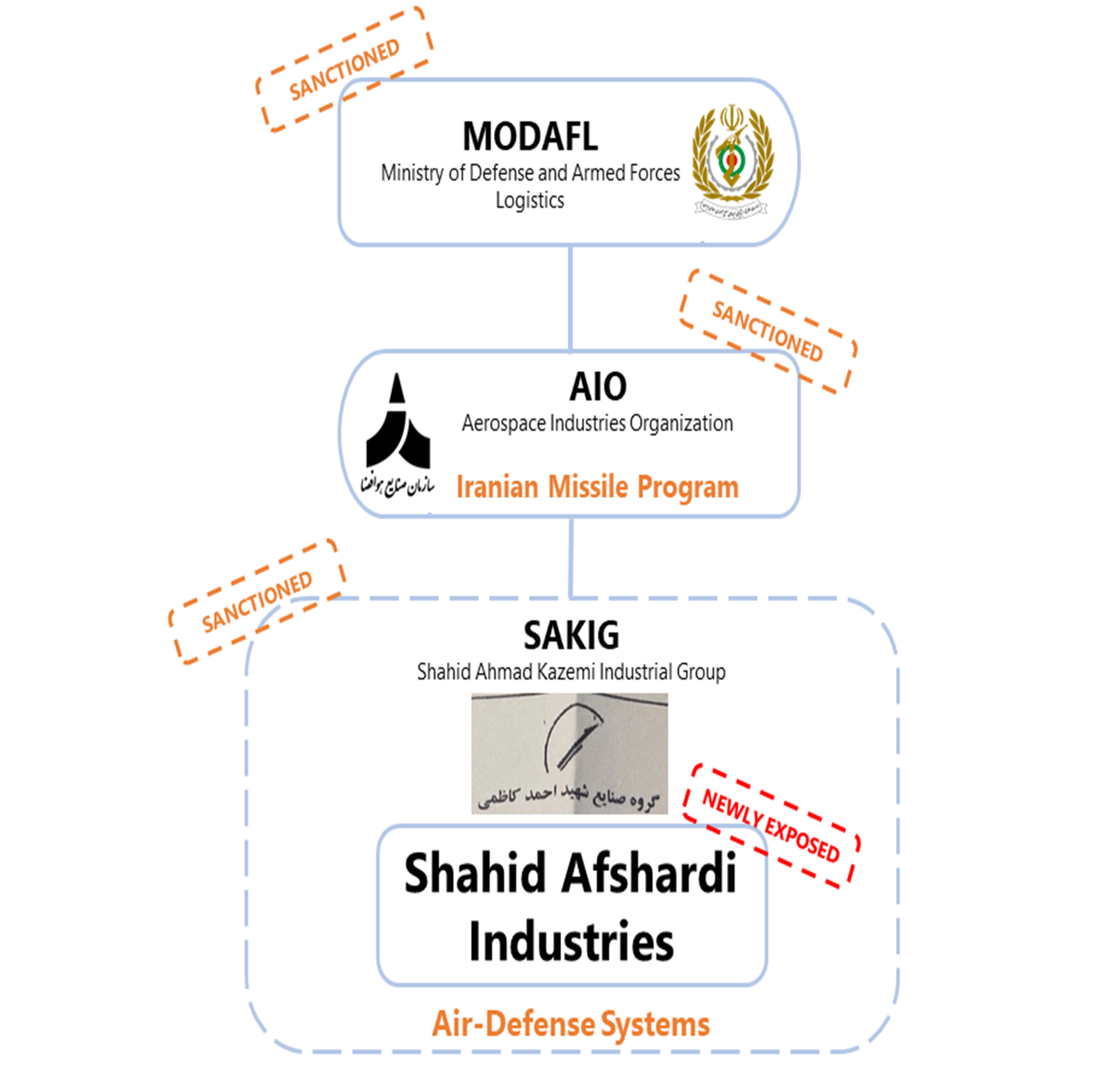
The insignia atop the first document belongs to the Aerospace Industries Organization (AIO). It is a MODAFL subsidiary, that oversees Iran’s missile program. AIO and its sub-entities control the development and production of ballistic, cruise and surface-to-air missiles. The US designated the AIO for non-proliferation of weapons of mass destruction (NPWMD) and it also appears on the prestigious UN and EU sanctions lists.
Shahid Ahmad Kazemi Industrial Group (SAKIG) is the AIO’s subsidiary that specializing in air-defense weapon-systems. SAKIG is also designated by the US and the UN. Among its subordinate industries are Shahid Afshardi Industries, which we expose here for the first time as an importer of sanctioned air-defense systems components. To our knowledge, Shahid Afshardi’s link to the AIO and its role in the missile program were previously unknown. The Documents are singed by the director of Shahid Afshardi Industries – Seyyed Jafar Mojtahed Najefi (سيد جعفر مجتهد نجفى), and by all other meeting participants.
SAMs & Sanctions
Surface-to-air missiles (SAMs) fall under the arms embargoes and sanctions imposed on Iran. The UN Security council reinstated the Snapback sanctions mechanism in September 2025, prohibiting the supply, sale or transfer of arms, including missiles systems, as defined by the UN Register of Conventional Arms, which covers SAMs.
Recent media reports have repeatedly highlighted China’s supply of dual-use technologies and materials for Iran’s drone and missile programs, consistent with the evidence presented here. The Servo engines (also known as Servomotors) sold by Hedsa Co. have both civilian and military applications: they are commonly used in drones and missiles, and therefore should be subject to strict export controls.
The Navab is a naval system that can launch multiple short-range anti-aircraft missiles from a warship. The Sayyad 4 is a long-range, high-altitude SAM employed primarily in the Bavar-373 air defense system. Both systems are expressly designed to engage drones, aircraft and cruise missiles, and have no civilian counterpart.
China: Iran’s Primary Sanctions Evasion Hub
China is poised to become even more pivotal for Iran after the severe damages its military industries sustained in the most recent conflict, that reportedly crippled its weapon- manufacturing capacity. Up to that point, Iran’s dealings with China were limited to specific areas of interest. Moving forward, China is likely to become its main supplier and buyer across the board. Accordingly, the use of Shadow Banking networks in China is expected to rise.
Due to the war, the Islamic Republic has become less self-sufficient in terms of arms production and became more dependent on China, but Beijing does not share that reliance. We advise against the horrible mistake of rescuing the crumbling Islamic Regime. Earlier this month, Chinese banks received letters from the US Treasury, warning them against facilitating the flow of funds for illicit Iranian activity.
China should understand that by buying Iranian oil and supplying weapons it provides a vital lifeline to a regime that slaughters its own people and launches deadly ballistic missiles at Chinese GCC allies. To secure reliable oil flow, the Chinese must consider withdrawing their support from the Islamic Regime, let it fall, and establish a fair-trade relationship with the Iranian people – not the oppressive overlords.